
Original price was: £318.00.£97.99Current price is: £97.99.
- Prompt service, every time.
- Nature-friendly materials, for a better planet.
- Shop with Ease
- Effortless solutions, excellent customer care.

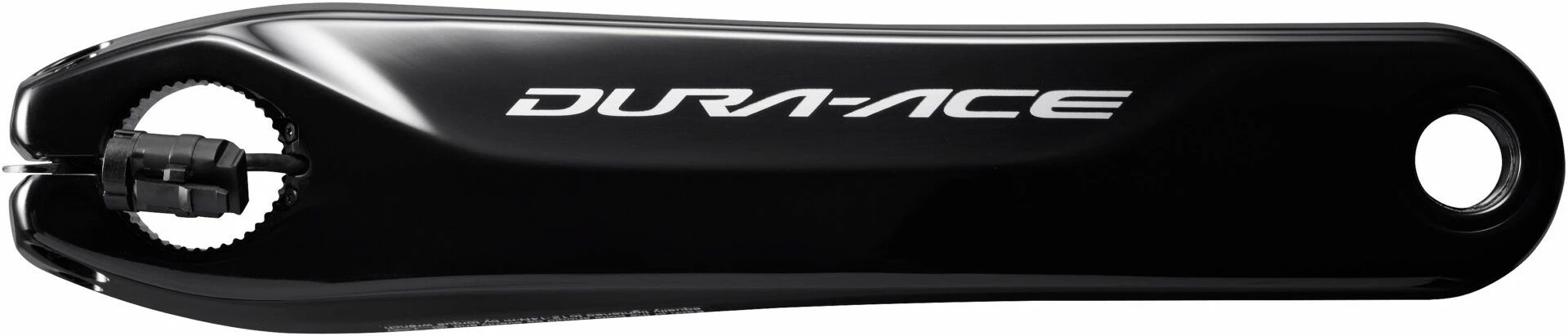
Genuine Shimano Dura-Ace FC-R9100 power meter crank arm.
Technology
Shimano Power Meter Technology
Power is more than a number.
Add meaning to your training with
Shimano’s Force Vector analysis.
While power is important, a simple output number doesn’t give you the full picture. Understanding how you develop
power and finding ways to improve efficiency can unlock new levels of performance. Shimano’s Force Vector
feature gives you real-time feedback on your pedal stroke, providing a more complete picture of your effort.
Visualize pedaling efficiency.
Arrows indicate the direction
and amount of force you’re applying to the pedals. Blue arrows show force rotating your cranks forward while red
arrows represent force opposing transmission to the rear wheel.
Force Vector is made possible
by Shimano’s expertise in designing and manufacturing cranks.
When designing power meters, Shimano engineers consider crank structure, the manufacturing process, materials
used, and how a crank flexes under load.
It’s this expertise that allows Shimano to achieve such accurate Force Vector measurement. Using the latest
technology and Shimano’s industry-leading knowledge, the latest Shimano power meters are powerful training
tools.
Optimal sensor placement.
Shimano power meters contain a total of 24 sensors (12 on each side) in a full bridge configuration*.
To accurately separate the force applied to the cranks in the tangential direction and normal direction, each
sensor is positioned at an angle to compensate for crank deformation.
This uniquely-designed sensor increases the precision of measurement and enables Force Vector measurement.
Full bridge configuration:
A sensor circuit configuration that improves temperature compensation with large sensor output.
Unified left-right design.
Although many power meters over the world
have a separate left-right configuration,
Shimano power meters have a unified left-right configuration.
A lithium-ion battery is incorporated inside the spindle
that connects the left and right cranks,
and provides power to the left and right sensors.
Wiring the left and right sensors together
eliminates minor deviations in measurement time
and enables accurate measurement of
power on both sides.
Long-life
battery.
Power meters that have a lot of sensors and send a large amount of data have high power consumption. However,
Shimano power meters achieve low power consumption thanks to a unique circuit configuration. A rechargeable
lithium-ion battery enables long-term use while contributing to precision. The EW-EC300 Di2 charging connector
is used for charging, making bicycle battery management easier.
Power precision.
Power measurement error is determined by the accumulation of load measurement error, time measurement error, and
crank length variation. In order to reduce these errors and variation, Shimano power meters are structurally
designed based on a careful examination of crank manufacturing methods. Additionally, thorough quality control
measures are applied during manufacturing and calibration. For measuring load, each individual crank is
calibrated in the factory before being shipped. Crank length is established in the processing stage, with
minuscule variance. For the time measurement, measurement precision is improved with the use of magnets, and at
a cadence of 90 rpm, the margin of error is a minuscule ± 0.15%.
Shimano power meter calibration.
Shimano load calibration conditions have been developed exclusively by Shimano based on a consideration of the
conditions required for bicycle power meters, and with reference to JIS B 7728 and ISO 376 standards.
Calibration is performed for a combined error of ± 1.5% or less with respect to the rated load.*
With regard to the rated load, loads of varying direction and size may be applied to multiple points on the
pedals depending on conditions, but the standard value is established as 800 N. Calibration is performed based
on a consideration of maximum loads, so that errors do not increase even under high-input loads as produced by
pro riders. This means that stable power values can be calculated for general riders up to pro riders.
Combined error: At the maximum deviation from a straight line that connects the no-load point and the rated load
point on the calibration curve, the combined error includes the following errors: Nonlinearity, Reproducibility,
Repeatability, Zero error.
Temperature compensation.
Because of the properties of aluminum and strain gauges, the zero-point balance of the gauge changes as the
temperature changes. This increases the load measurement error. To compensate for this, with Shimano power
meters, each and every crank is subject to temperature calibration in the factory. When a 2°C change from the
time of the zero offset occurs in the environment temperature, the zero point is automatically adjusted.
| Crank Arm Sizes | 165mm, 170mm, 172.5mm, 175mm, 180mm |
|---|---|
| Brand | Shimano |
| Colour | Black |
Be the first to review “Shimano Dura-Ace FC-R9100 Power Meter Crank Arm”
Related products
Chainsets & Cranks
Components
Chainrings
Components
Components
Reviews
There are no reviews yet.